
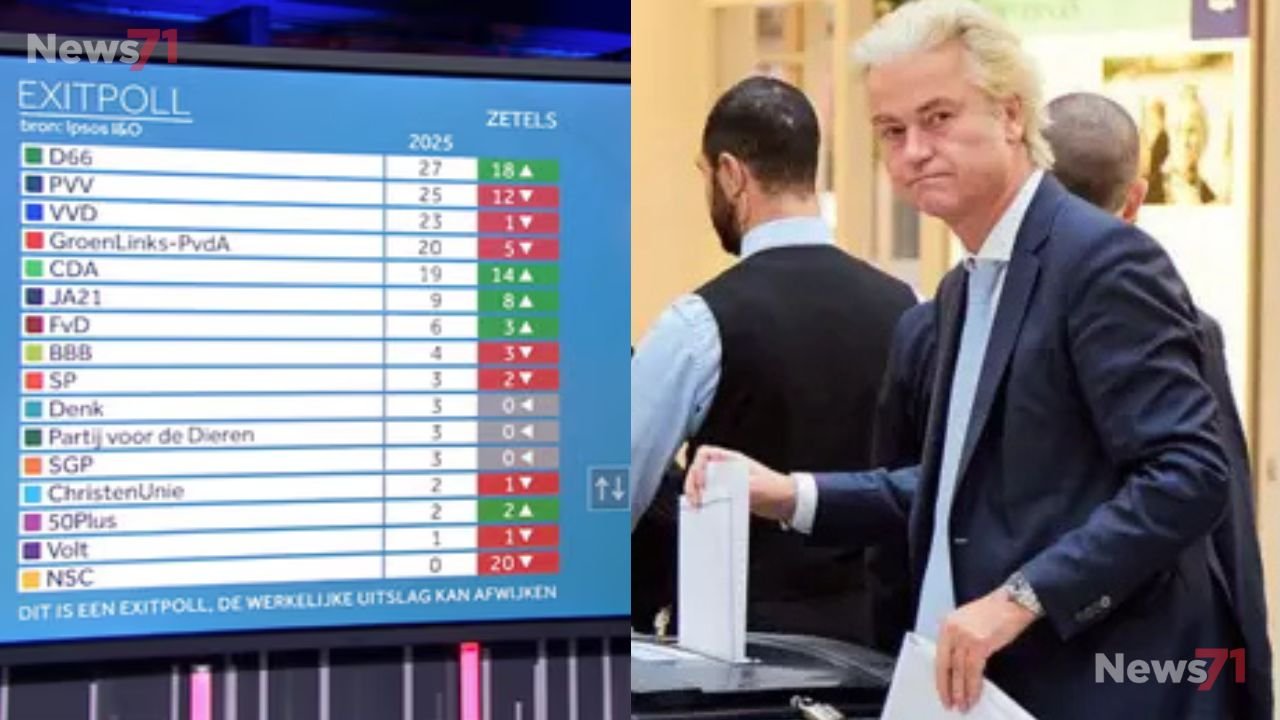
Dutch Election, Rob Jetten’s centrist-liberal party D66 and Geert Wilders’ anti-Islam Freedom Party (PVV) are locked in an exceptionally close race in the Dutch Election, according to the latest projections. With about 98% of votes counted, both parties are set to win 26 seats in the 150-member parliament, data from the Dutch news agency ANP showed on Thursday. Early exit polls had placed D66 slightly ahead, but the final count revealed a razor-thin margin of fewer than 2,000 votes separating the two frontrunners. Despite losing 11 seats compared to the last election, Wilders managed to secure his second-best result ever. Meanwhile, Jetten’s D66 has surged in support, marking its strongest performance in years. Both parties captured less than 17% of the national vote, leaving the balance of power dependent on smaller parties.
Three other political groups are close behind: the conservative-liberal VVD with 22 seats, followed by the GreenLeft-Labour alliance and the Christian Democrats. During the campaign, Wilders led in most polls, but his decision to collapse his own coalition in June over disputes about asylum and migration weakened his chances of forming a government. Major parties have since distanced themselves from him, ruling out cooperation. Jetten, just 38 years old, has become one of the rising stars of Dutch politics. His strong debate performances and frequent TV appearances, including on the popular quiz show The Smartest Person, boosted his public image and helped D66 double its projected seats in just weeks.
Dutch Election: Jetten’s D66 and Wilders Locked in Tight Race for Power

He has promised to form a stable and ambitious coalition government that reflects the country’s diversity. Potential partners include the Labour-GreenLeft alliance led by Frans Timmermans, the VVD under Dilan Yesilgöz, and the Christian Democrats. Jetten has also left the door open for smaller right-leaning parties like JA21 to join talks, but securing a 76-seat majority will be challenging. For Timmermans, the Dutch Election was a major setback. Once polling second, his alliance is now expected to finish fourth. He expressed disappointment and announced plans to step down from leadership, acknowledging voters’ appetite for new leadership and ideas. Wilders, however, remains defiant, saying he will continue leading his party despite the losses. Political analysts like Matthijs Rooduijn from the University of Amsterdam said the PVV lost moderate voters while struggling to attract new supporters from other blocs.
RELATED POST: The Centrist D66 party made significant gains in the Dutch elections
At D66’s election night gathering in Leiden, supporters celebrated the party’s best-ever result with optimism. Jetten told the crowd that the results showed Dutch voters are ready to move beyond years of political stalemate and embrace progress. The Dutch Election was dominated by debates on housing shortages, migration, and economic uncertainty. Jetten’s D66 has pledged to address the housing crisis by building 10 new cities across the country, aiming to close a shortage of nearly 400,000 homes. Many Dutch voters say the outcome signals a desire for unity, ambition, and new leadership and Jetten’s challenge now is to turn that message into a lasting government.
Source: BBC